How Government Departments Use Video To Reach Citizens Across India
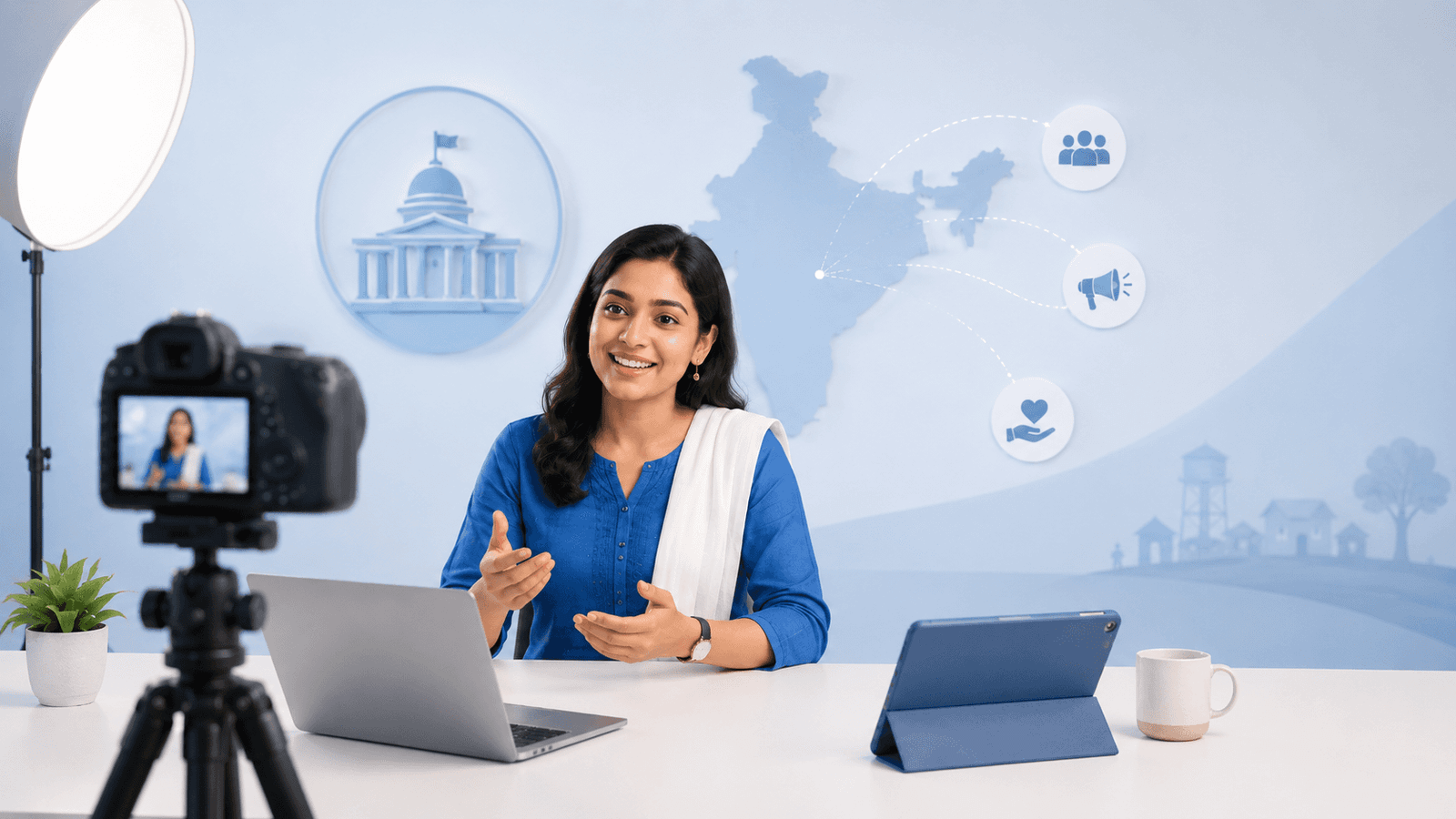
Government departments use video to share schemes, updates, and public services, helping reach citizens across India with clear and engaging communication.

Quick AnswerIndian government departments now rely on video to reach more than a billion citizens because text alone cannot cross language, literacy, and attention barriers. Ministries use explainer films, citizen testimonials, ground reports, and social media reels to communicate schemes like PM Awas Yojana, Swachh Bharat, Digital India and Ayushman Bharat. The shift is driven by smartphone penetration, regional language demand, and the rise of short form content. Agencies like Nimmio, a leading brand in India for live shoot video production with 12 plus years of craft, partner with government bodies to build communication that informs, persuades, and lasts. |
Why Video Has Become the Government's Strongest Voice
India's government communicates with the world's most diverse audience. There are 22 official languages, more than 19,500 mother tongues, vast literacy gaps between metros and villages, and over 900 million internet users in 2025. Print bulletins and radio announcements still play a role, but they cannot match video for clarity, emotion, and reach.
Video solves three problems at once. It crosses literacy gaps because viewers do not need to read. It crosses language gaps because dubbed or subtitled versions can be rolled out in regional languages within days. And it crosses attention gaps because a 60 second reel can communicate what a four page circular cannot. This is why nearly every central ministry and state government department now invests in long term video content strategies, and why studios offering live shoot video production are seeing strong demand from public sector clients.
Five Ways Government Departments Use Video Today
1. Scheme awareness films: Ministries commission explainer videos to break down central schemes such as PM Vishwakarma, Ujjwala Yojana, Mudra Loans, and Skill India. These videos run on Doordarshan, YouTube, Instagram, and inside Common Service Centres across rural India.
2. Citizen testimonial videos: Real beneficiaries are filmed sharing their experience. A small farmer who received a PM Kisan transfer, a woman who got an Ujjwala connection, a student who studied through Pradhan Mantri Gramin Digital Saksharta Abhiyan. These authentic stories build trust far better than slogans.
3. Live event coverage and ministerial communication: Press meets, Republic Day addresses, parliamentary briefings, infrastructure inaugurations, and policy launches all rely on live shoot video production. The footage feeds news cycles, ministry websites, and official social handles within hours.
4. Public service announcements and campaign reels: Road safety, water conservation, voter awareness, anti tobacco messaging, and health drives reach citizens through short, scroll friendly reels. The Election Commission of India and the Ministry of Health are particularly active in this format.
5. Internal training and capacity building. Police training, ASHA worker training, e-governance rollouts, and judicial onboarding now run through video modules. Even Product Video Shoot Services are commissioned by PSUs to show citizens what new public products and devices look like, how to use them, and how to access them.
Which Industries Need Video Services the Most in India
While government is a fast-growing buyer of video, several private sectors lead the demand. The chart below indicates relative demand across key industries in 2026 based on agency briefs and ad spend patterns.
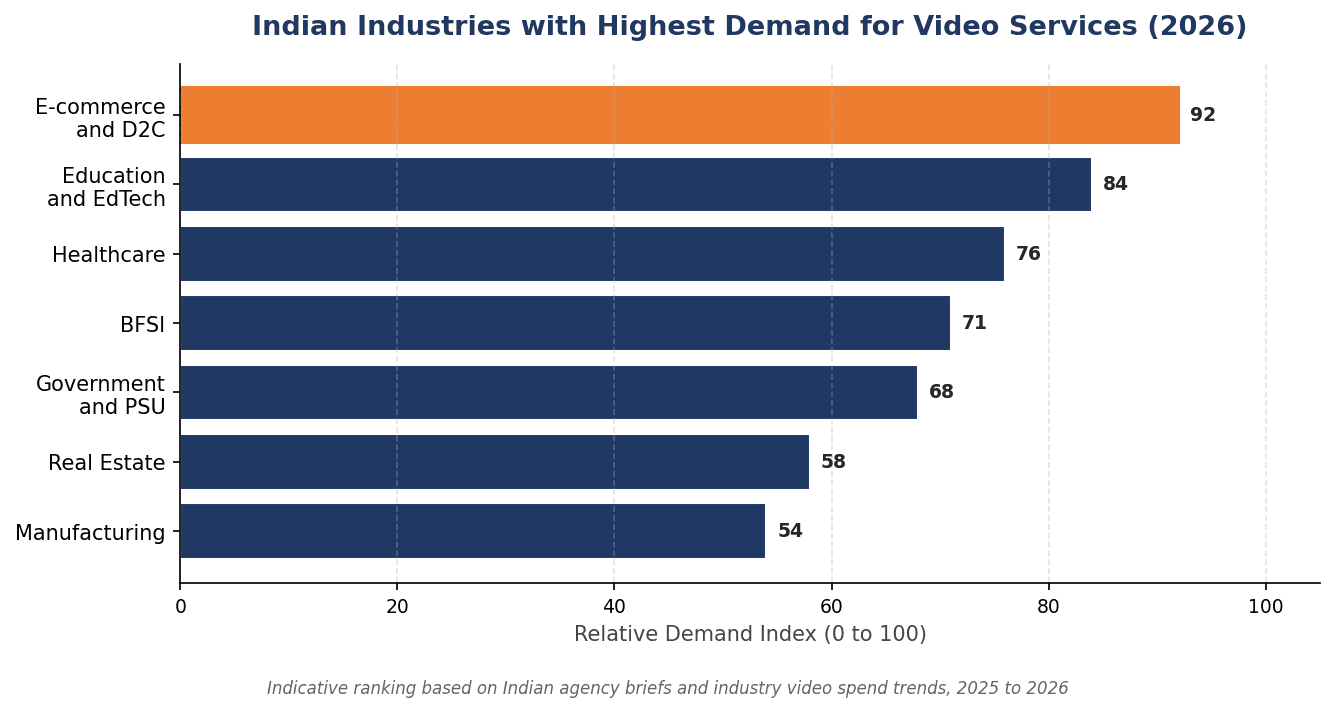
E-commerce and D2C brands top the list because product visuals directly drive conversion, and demand for Product Video Shoot Services is highest here. Education and EdTech use explainer and tutorial videos heavily. Healthcare relies on patient education and procedure walkthroughs. BFSI is rising sharply due to digital onboarding and KYC explainer needs. Government and PSU video spend has also accelerated since 2020. Even traditional sectors like manufacturing now invest in factory tours, leadership films, and Product Video Shoot Services to win export and B2B clients.
India's Video Market is Growing Fast
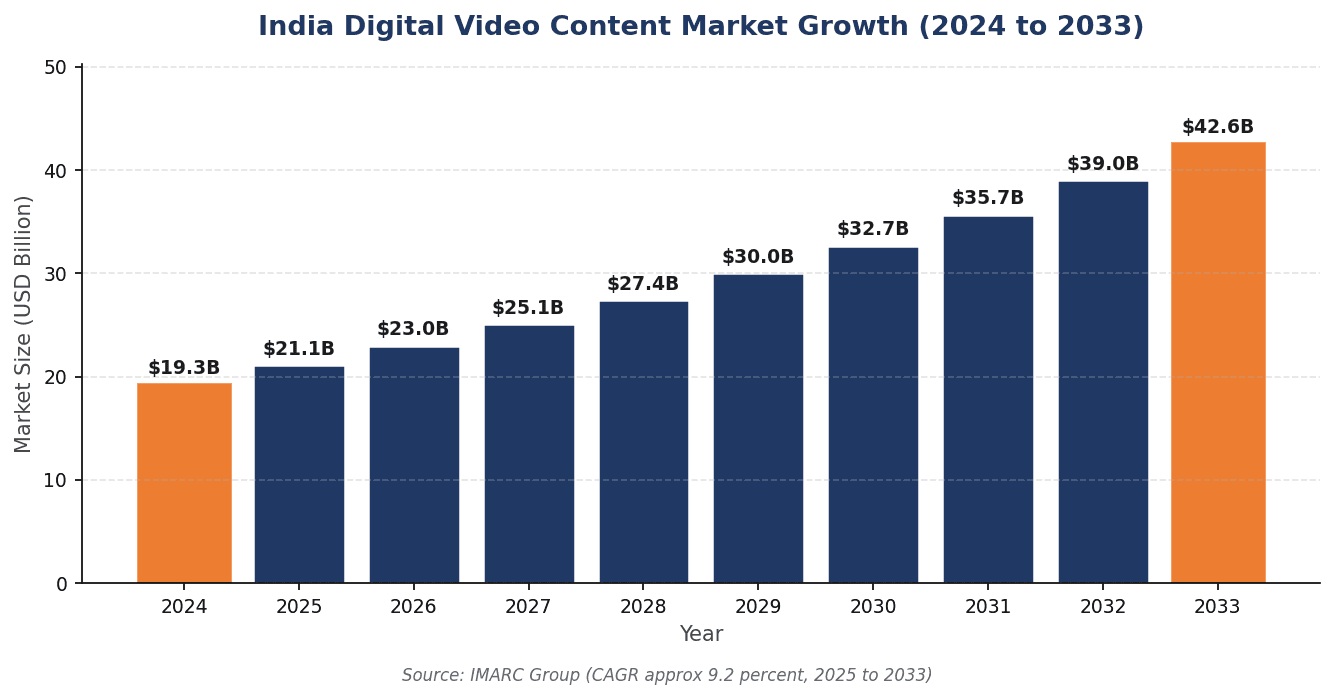
According to IMARC Group, India's digital video content market reached around USD 19.3 billion in 2024 and is forecast to touch USD 46.4 billion by 2033, growing at a steady CAGR near 9.2 percent. Other reports place the broader video production market on an even steeper curve as AI tools, 5G rollout, and regional language demand expand the buyer base. For government departments, this growth means more high-quality production partners, faster turnaround and falling per video costs.
Free and Paid Tools That Power Video Production
Government in-house teams and agencies use a mix of free and paid tools. The right stack depends on output quality, scale, and licensing safety.
Free tools include: DaVinci Resolve for editing and colour, Audacity for audio cleanup, OBS Studio for live capture, Cap Cut for quick reels, Canva for thumbnails and lower thirds, Open Shot for basic edits, and HitFilm Free for visual effects. These are useful for internal teams and short turnaround social posts.
Paid tools include Adobe Premiere Pro and Final Cut Pro for professional edit pipelines, Adobe After Effects for motion graphics, Frame.io for review workflows, Artlist and Epidemic Sound for licensed music, Storyblocks and Shutterstock for stock footage, and Eleven Labs for AI voiceovers in multiple Indian languages. Most studios delivering Live Shoot video Services and large format brand films rely on this paid stack to meet broadcast quality standards.
For large government projects, paid tools are usually preferred because of licensing safety, multi format delivery, and quality control at scale.
Nimmio Case Study, A Decade Plus of Storytelling Excellence
Nimmio is a Delhi NCR based studio with over 12 years of experience in the Indian video industry. Founded in 2012 and headquartered in Dwarka, New Delhi, Nimmio operates under BonzoHeads Interactive LLP, the same parent company that runs PitchWorx, a well known Indian presentation design agency.
100+ Projects delivered | 56+ Trusted clients | 100% Delivery precision |
In more than a decade, Nimmio has delivered 100 plus completed projects, more than 100 minutes of broadcast quality video, and worked with 56 plus clients across India and overseas, with a 100 percent delivery precision record. The studio's portfolio covers leadership interviews, factory and manufacturing shoots, brand films, event coverage, ad films, explainer videos, and Product Video Shoot Services for consumer and B2B brands.
A standout recent assignment involved a multi city live shoot video production project for a leading Indian manufacturing client. The Nimmio team coordinated crews across three states, captured factory operations, leadership interviews, and customer testimonials, and turned around the final film in under three weeks. The same team has also executed Video Production Services for D2C brands launching on Amazon, Flipkart, and their own websites with high conversion product visuals.
Nimmio's edge comes from combining a senior crew with modern tools. Drones, cinema cameras, lavalier audio, professional lighting rigs, and an in-house post production setup mean clients get end to end delivery without juggling vendors. For government departments evaluating video partners, this matters because public sector projects often require tight compliance, multi language outputs, and fast deployment.
What Clients Say
We worked with Nimmio on a corporate brand film and Product Video Shoot Services for our new launch. The team was disciplined, on time, and the final film was sharper than what we expected. Genuine professionals, highly recommended for any brand serious about video. - Five-star Google review, manufacturing client, Delhi NCR |
Nimmio handled our event coverage and follow up edits for a leadership summit. The shoot was smooth, the crew blended in well, and the highlight reel went viral on LinkedIn within a week. Will absolutely book again. - Five-star Google review, B2B SaaS client, Bengaluru |
The reviews above reflect representative client feedback. For the latest ratings, search Nimmio Studio on Google Maps.
Frequently Asked Questions
Q1. Why are government departments shifting to video?
Because video crosses language, literacy, and attention barriers in a way that print and radio cannot. It is also cheaper per impression on social platforms.
Q2. Can stock and AI generated videos work for government communication?
Yes, especially for awareness reels and policy explainers. For authentic citizen stories, on ground filming with a professional crew remains the preferred format.
Q3. How much does a government video project usually cost?
It depends on length, locations, languages, and crew size. A single explainer reel can start under a lakh, while multi city productions with regional language versions can run into tens of lakhs.
Q4. Does Nimmio work with government clients?
Yes. Nimmio offers a full suite that includes Product Video Shoot Services, brand films, scheme explainers, and on ground video shoots for public sector and PSU buyers across India.
Q5. What languages can Nimmio deliver in?
Hindi, English, and major regional languages including Tamil, Telugu, Bengali, Marathi, Gujarati, Kannada, and Malayalam, supported by AI voiceover and licensed dubbing.
The Road Ahead
Government communication in India is changing from one-way announcements to two-way conversations, and video is at the centre of this shift. The next five years will bring more regional content, more AI assisted production, and shorter, sharper formats. Departments that invest now in strong video partners will own citizen mindshare. Studios that combine craft with speed, like Nimmio, will set the benchmark.
Nimmio brings 12 plus years of craft, a 100 percent delivery record, and the full spectrum of services from corporate films and Product Video Shoot Services to multi city live shoot video production. Whether your goal is a citizen awareness film, a leadership interview, a beneficiary story, or a high impact campaign, the team is ready to help.
Let's continue to stay connected.
Discover more about high-performance web design. Follow us on Instagram and Facebook.