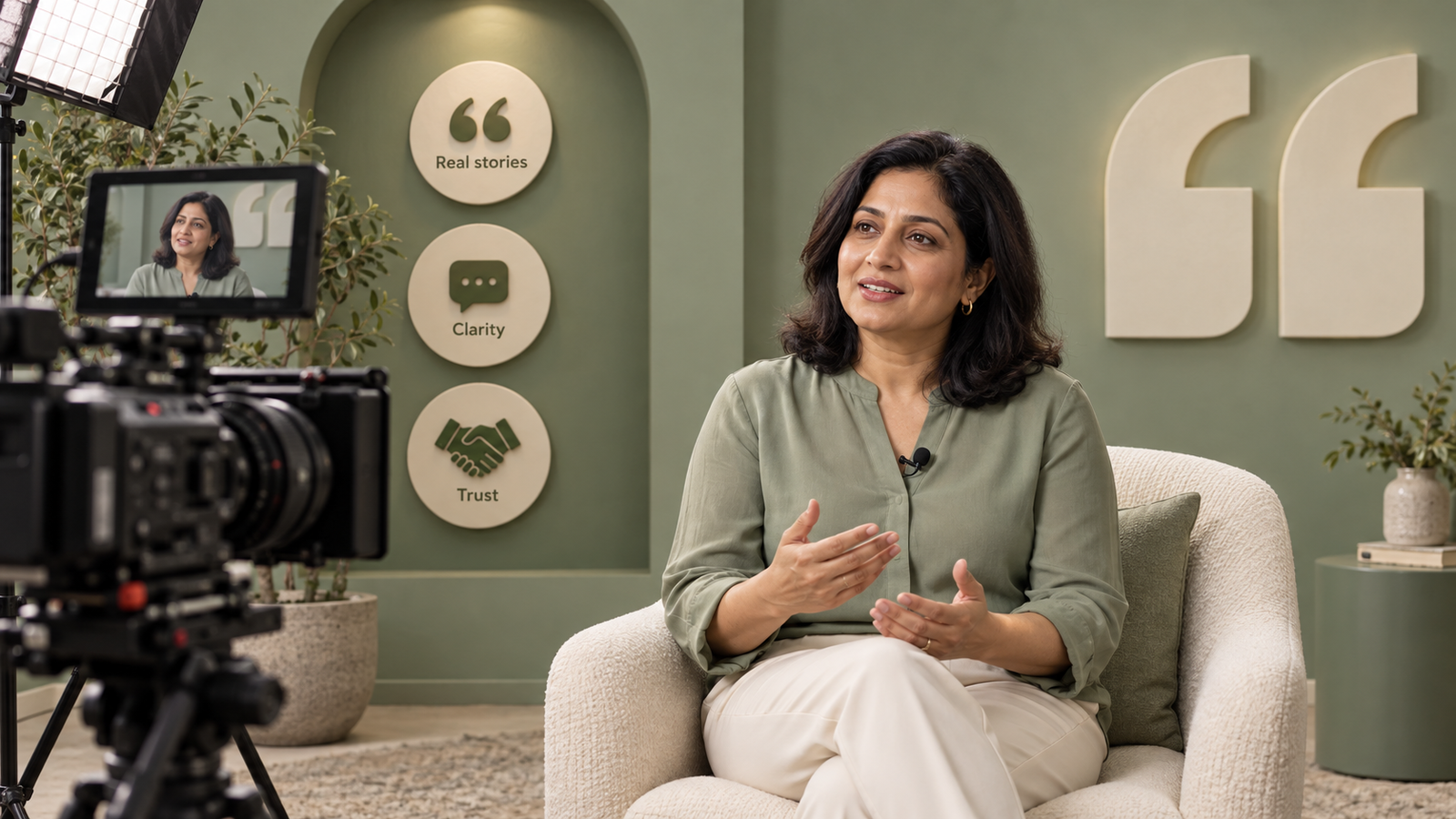
How Do You Film a Customer Testimonial Video That Builds Trust?
A practical walkthrough of planning, filming, and using customer testimonial videos that feel honest and persuasive for Indian businesses.

A customer testimonial video builds trust when it captures a real customer telling a specific, honest story about a problem you helped them solve. The camera work matters less than you might expect. What earns a prospect's confidence is the preparation behind the shoot: choosing the right customer, asking questions that produce natural answers, and editing for clarity without scrubbing away the personality. Get those three things right and even a modest shoot will feel credible.
This article walks through the full process, from picking a customer to using the finished video across your marketing, with practical pointers for Indian founders, startups, SaaS teams, and agencies.
Why customer testimonial videos work
People trust other people more than they trust brands talking about themselves. A testimonial video lets a prospect hear someone like them describe a familiar problem and the result they got. That recognition is what moves a hesitant buyer closer to a decision.
For early-stage companies this matters even more, because the brand is still unknown and the buyer is weighing risk. A genuine customer voice does a lot of the reassurance work for you. If you want the broader argument for using video to build credibility, we covered it in why corporate videos help Indian startups build customer trust faster.
How to choose the right customer to feature
The customer you pick decides most of the outcome. A great speaker with a weak story is less convincing than an ordinary speaker with a result that your target buyer wants.
Look for a customer who checks these boxes:
- They resemble the audience you are trying to win. A SaaS buyer trusts another operator in a similar role and company size.
- They had a clear before-and-after. A specific change is more persuasive than general praise.
- They are comfortable on camera, or at least willing. Nervousness can be edited around, but reluctance shows.
- They can share something concrete, such as how a task got faster or a worry that went away.
Avoid featuring only your largest client if their situation looks nothing like your typical buyer. One relatable mid-size customer often outperforms a famous logo.
How to prepare before the shoot
Write questions, not a script
A scripted testimonial sounds like an advertisement, and viewers can tell. Instead, prepare a short list of open questions and let the customer answer in their own words. Good prompts include: What problem were you facing before? What made you choose us? What changed after? What would you tell someone considering it?
Scripting has its place in other formats. If you are producing a narrated brand film rather than a testimonial, our notes on how to write a script for a corporate video apply. For testimonials, keep the customer unscripted.
Brief the customer in advance
Send the questions a few days before filming so the customer can gather their thoughts, but ask them not to memorise answers. Tell them the expected length, what to wear, and that stumbles are fine because you will edit. A relaxed customer gives better material than a rehearsed one.
How to film the testimonial
Setting and framing
Film in a place that reflects the customer's world, such as their office or workspace, rather than a blank studio wall. A real environment adds credibility. Frame the customer slightly off centre, looking at the interviewer who sits just beside the camera, not into the lens. This creates a natural conversational feel instead of a direct sales pitch.
Shoot some extra footage of the customer working, the office, or the product in use. These cutaway shots, often called B-roll, let you cover edits and keep the video visually interesting.
Sound and lighting
Clean audio is the single biggest technical factor in whether a testimonial feels professional. Use a clip-on or dedicated microphone rather than the camera's built-in mic, and record somewhere quiet. If you are filming on location, our guide to recording clean audio on location covers the common pitfalls.
For lighting, soft and even beats dramatic. Position the main light to one side at roughly a forty-five degree angle and avoid harsh shadows on the face. Natural window light works well when the sun is not moving across the frame. Testimonials sit within the wider craft of live shoot video production, where setup and location handling make the difference.
How to edit for honesty and clarity
Editing a testimonial is about tightening, not rewriting. Cut filler, long pauses, and tangents, but keep the customer's actual words and tone. Build the final piece as a short story: the problem, the turning point, and the result.
A few editing recommendations:
- Keep most testimonials between sixty and ninety seconds for social and web use. A longer cut of two to three minutes can live on a sales page.
- Add on-screen captions, since many people watch without sound.
- Use a simple name and role title so viewers can judge relevance at a glance.
- Resist over-polishing. A slightly imperfect delivery reads as real, while a flawless one can read as staged.
How to use the testimonial video across your marketing
One testimonial can support many parts of the buyer journey. As a hypothetical example, a startup might place the full video on its pricing page, cut a fifteen second clip for a social ad, and pull a single strong quote as a graphic for a sales email. The same shoot then works in three places.
Planning that reuse before you film saves time and money. Our walkthrough on how to repurpose one video shoot into multiple content pieces shows how to plan a single session for several outputs.
A simple decision checklist
Before you commit to a testimonial shoot, run through these questions:
- Does this customer match the buyer I want to reach?
- Can they describe a specific, believable result?
- Do I have questions ready instead of a script?
- Can I guarantee clean audio and even lighting?
- Do I know where this video will be used before filming starts?
If you can answer yes to most of these, you are ready to film something that will genuinely build trust.
Frequently asked questions
How long should a customer testimonial video be?
For most web and social placements, aim for sixty to ninety seconds. Keep a longer two to three minute version for a sales or case study page where the viewer is already engaged and wants detail.
Should I pay customers to appear in a testimonial?
Paying for a testimonial undermines its credibility and can mislead viewers. It is better to feature genuinely satisfied customers and, if needed, offer a small non-cash thank you such as early access to a feature. Keep the opinions entirely their own.
What if my customer is not comfortable on camera?
Many people are nervous at first. Warm up with easy questions, keep the crew small, and film more than you need so you can select the best moments. If someone remains uneasy, an audio interview with supporting footage, or a written quote with photos, can still work.
Can we film a testimonial remotely?
Yes. A remote testimonial can be recorded over a good quality video call or by guiding the customer to film themselves on a recent phone. The trade-off is less control over sound and lighting, so share simple setup instructions in advance and expect a slightly less polished result.
How many testimonial videos does a business need?
There is no fixed number. A useful starting point is one strong testimonial for each main audience or use case you sell to, so different buyers can see someone like themselves. You can add more over time as you win customers with distinct stories.
Bringing it together
A customer testimonial video builds trust through honest selection, good questions, clean production, and careful editing rather than through expensive gear or heavy scripting. Pick a customer who mirrors your buyer, let them speak naturally, protect your audio and light, and plan where the video will live before you shoot. If you would like help planning, filming, or editing testimonial videos that feel real and persuasive, the team at Nimmio works with founders and marketing teams to do exactly that.
Let's continue to stay connected.
Discover more about high-performance web design. Follow us on Instagram and Facebook.